


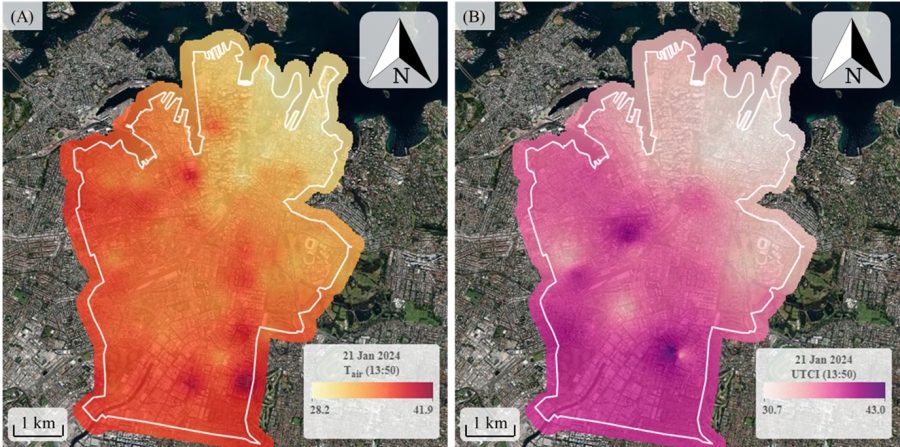
Blacktown and City of Sydney each partnered with WSU Urban Transformations Research Centre (UTRC) to compete microclimate studies during summer 2023/24. The studies provide critical insights in local hotspots and cool places which can inform mitigation and adaptation strategies
Submitted by Professor Sebastian Pfautsch, Western Sydney University Urban Transformations Research Centre
Blacktown
In partnership with Western Sydney University, Blacktown City Council has completed a landmark study - Benchmarking Summer Heat Across Blacktown’s Diverse Urban Landscapes. Conducted over summer 2023/24, the research monitored near-surface air temperatures at 220 locations using tree-mounted sensors. The findings revealed long-term summer air temperature variations of up to 2.5°C across the City, identifying cooler areas like Shanes Park and Nurragingy Reserve, and hotter zones in industrial precincts and low-rise suburbs such as Arndell Park and Willmot.
This locally focused data highlights stark microclimatic heterogeneity across the LGA and often surpasses readings from the nearest Bureau of Meteorology station in Horsley Park. The insights will inform urban planning, development controls, and heat mitigation strategies, with case studies guiding future resilience efforts.
The full report will be published on Western Sydney University’s website. In the meantime, view the briefing note here. This research is a critical step toward a cooler, more climate-resilient Blacktown.
City of Sydney
In summer, Sydney is at its world best. But summers are getting hotter and air temperatures during extreme heat events can be above 40°C in parts of the city, presenting health risks for residents, workers and tourists. Until now it was unknown where the city’s critical hotspots and cool places are, which imposed limitations to strategic and effective planning of heat mitigation strategies.
In 2023, The City of Sydney partnered with scientists from the Urban Transformations Research Centre at Western Sydney University to document the variation of near-surface air temperature and relative humidity across its LGA. Microclimate data was collected at 127 locations, resulting in more than 1.5 million measurements of air temperature and relative humidity. The final project report was published in March this year and is available at: https://www.cityofsydney.nsw.gov.au/research-reports/mapping-summer-microclimates. The website also outlines key findings and recommendations how to cool Sydney.
 © 2021. All Rights Reserved.